Understanding Autism
Autism Spectrum Disorder is a complex neurodevelopmental condition that affects communication, social interaction, and behavior. Understanding autism helps families recognize early signs, explore treatment options, and support individuals in reaching their full potential.

What is Autism Spectrum Disorder?
- Intricate neurodevelopmental disorders affecting children.
- Usually appear in the first three to four years of life.
- Difficulty understanding simple commands and everyday phrases.
- Challenges in interpreting emotions and non-literal meaning.
- Impact on understanding, problem solving, speech, social interaction, and behavior.
- According to the current DSM-5 guidelines, it is characterized by challenges in three areas: social communication, Emotional reciprocity, and restricted, repetitive patterns of behavior. As it is a "spectrum" disorder, each person's strengths and support needs vary.
Early Intervention program can improve a child's development
Prevelance in Autism
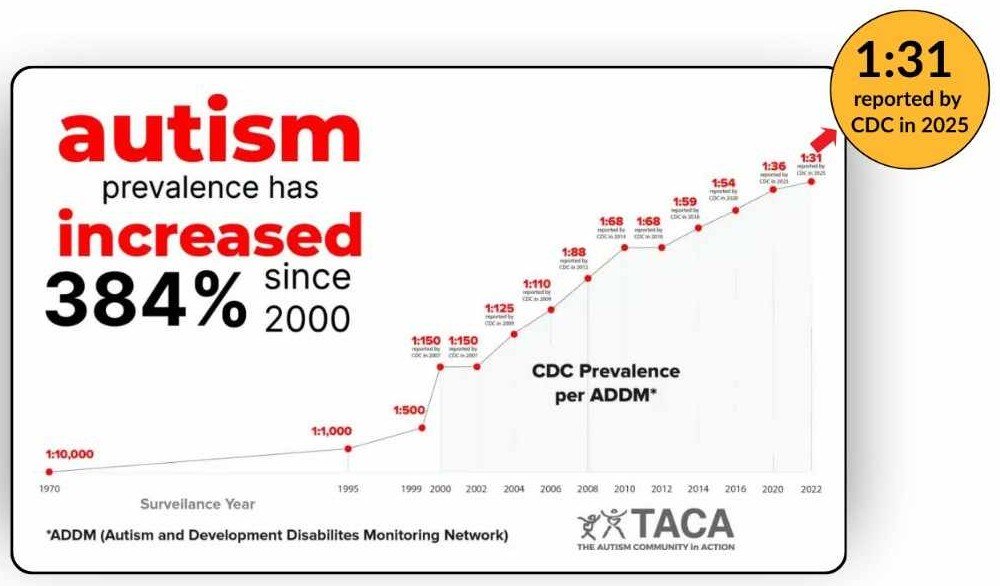
According to the current estimates from the Centers for Disease Control and Prevention (CDC) Autism and Developmental Disabilities Monitoring (ADDM) Network, about 1 in 31 children in the USA are on the Autism Spectrum.
Graph from the CDC website showing increase in Autism prevalence.
Levels of Autism
Introduction

In the DSM-IV-TR, these symptoms were grouped into separate disorders, including Asperger’s Syndrome, Pervasive Developmental Disorder-Not Otherwise Specified, Childhood Disintegrative Disorder, Rett Syndrome and Autistic Disorder. Today, all of these separate disorders are no longer used, and they are all included in a single diagnosis: ASD. These disorders are, in fact, different manifestations of one single disorder. The DSM-5 categorizes Autism Spectrum Disorder (ASD) into three distinctive levels. These three levels should not be used to define an individual’s “functioning” in a general context. Rather, they define the support that an individual requires in their life.
Level 1: "Requiring Support"

Level 1: "Requiring Support"
In this level of ASD, an individual is able to communicate using full sentences and can participate in communication. However, they might experience difficulties with the “back-and-forth” nature of social interactions. This might cause difficulties for the individual in initiating social contact. In addition, they might respond in ways that are perceived as unsuccessful. Inflexibility might cause difficulties for an individual in being independent. This is because they might experience difficulties in changing between activities and using their time.
Level 2: "Requiring Substantial Support"

Individuals in this level will exhibit more severe difficulties in verbal and nonverbal social communication skills. Their difficulties in social interaction will be evident even when support is provided. They may be able to use short sentences for communication, and their interactions may be restricted to very narrow special interests. At this level, individuals may have difficulties in coping with change or repetitive behaviors that are evident in their daily lives.
Level 3: "Requiring Very Substantial Support"